.webp)

The concept of the "Lucky Block" has evolved from a simple modded curiosity into a cornerstone of emergent gameplay within physics-based destruction simulators. In the specific ecosystem of Kick a Lucky Block, the interaction between the player and the block is not merely a mechanical cycle of input and reward; it is a ritualistic engagement with a high-entropy digital object. This article explores the deep architectural philosophy, the mathematical beauty of its loot tables, and the psychological impact of tactile destruction in a world governed by simulated gravity and chaotic variables.
1. The Genesis of the Gilded Cube: From Static Asset to Dynamic Entity
The Lucky Block did not emerge in a vacuum; it was born from the desire to inject unpredictability into rigid voxel environments. In its earliest iterations, the block was a static container, but in the context of Kick a Lucky Block, it has been elevated to a dynamic entity. This shift represents a move from "opening" a box to "interacting" with a physicalized object, where the force of the kick dictates the spatial distribution of the resulting loot.
This physicalization changes the player's relationship with the object. When a block is no longer a stationary chest but a physics-enabled cube that reacts to torque and velocity, the act of "kicking" becomes a meaningful expression of agency. The block is a vessel of potential energy, waiting for the player's kinetic input to trigger a state-change from a singular, solid mass into a chaotic explosion of items, mobs, or environmental hazards.
2. The Architecture of Chaos: Decoding the Probabilistic Engine
At the heart of the experience lies the Probabilistic Engine, a complex algorithm that governs the outcome of every interaction. This is not a simple random number generator (RNG) but a tiered weight system that balances dopamine release with "negative" outcomes. The engine must ensure that the player feels the "near-miss" effect—the sensation that a legendary item was just one roll away—to maintain the gameplay loop's integrity.
The Tiered Weighting System
The engine operates on a hierarchy of rarity:
- Common (60%): Consumables and minor stat boosters.
- Uncommon (25%): Basic gear and environmental modifiers.
- Rare (10%): Significant power-ups or rare entity spawns.
- Legendary (4%): Game-altering artifacts.
- Calamitous (1%): Destructive events that reset progress or challenge the player's survival.
The Mathematical Fragility of Luck
The distribution of these outcomes is often modeled using a modified Gaussian distribution to prevent "dry streaks." If a player kicks fifty blocks without a Rare drop, the engine subtly shifts the weights, a process known as Pity Logic, ensuring the psychological "hook" remains firmly embedded in the user experience.
3. The Kinetic Aesthetic: The Role of Physics in Reward Perception
The transition from a click-to-open interface to a kick-to-break mechanic is a masterclass in Tactile Satisfaction. In Kick a Lucky Block, the destruction of the cube is partitioned into fragments using Voronoi shattering. This means no two blocks break in exactly the same way. The visual feedback of a block splintering under the force of a simulated impact provides a sensory reward that precedes the actual loot reveal.
This "destruction-first" philosophy taps into a primal human urge to dismantle structures. By linking the acquisition of wealth (loot) to the physical destruction of a golden icon, the game creates a feedback loop where the act of breaking is as pleasurable as the act of receiving. The haptic feedback and the sound design—a mix of glass shattering and metallic clinks—serve to reinforce this cognitive association.
4. The Socio-Economic Impact of Infinite Loot Generation
Within the micro-economy of the game, the Lucky Block serves as the primary driver of Inflationary Dynamics. Because the blocks can be generated or found with high frequency, the value of "Legendary" items is constantly in flux. The game must reconcile the infinite supply of blocks with the need for a stable power progression, leading to a system of "Disposability."
The Cycle of Obsolescence
- Acquisition: The player kicks a block and receives a high-tier sword.
- Dominance: The sword allows for faster block-kicking or mob clearing.
- Saturation: The player eventually finds a "God-Tier" item, rendering the previous sword obsolete.
- Disposal: The item is sold or discarded, fueling the need for the next kick.
This cycle mirrors real-world consumerism, where the "new" is perpetually chased, and the "current" is merely a stepping stone. The Lucky Block is the ultimate engine of this consumerist simulation, providing a never-ending stream of novelty that keeps the player's inventory in a state of permanent revolution.
5. Environmental Storytelling through Random Spawns
The Lucky Block is not just a loot container; it is an Event Trigger. Some outcomes are not items but localized environmental changes—spawning a miniature boss, generating a sudden lava pool, or altering the gravity of the immediate area. These events turn the game world into a living, reactive canvas where the player's actions have unforeseen consequences on the terrain.
This creates "emergent narratives." A player might kick a block intending to find armor, but instead spawns a "Black Hole" event that pulls in nearby mobs. The resulting chaos becomes a story the player tells, moving the game away from a static grind and toward a series of unscripted, high-stakes moments. The block, therefore, acts as the narrator of the player's journey, writing the script one kick at a time.
6. The Psychology of the "Negative Outcome"
A crucial component of the Lucky Block’s design is the Risk-Reward Conflict. If every block contained gold, the gold would be worthless. To provide value to the "Lucky" outcomes, the game must include "Unlucky" outcomes—traps, explosions, or debuffs. These negative outcomes serve as the "salt" that enhances the "sweetness" of the rare drops.
"The fear of the trap is what makes the shimmer of the legendary item meaningful. Without the risk of a TNT spawn, the kick loses its tension."
This tension triggers a localized fight-or-flight response. When a block is kicked, there is a micro-second of anticipation where the player prepares for either a windfall or a disaster. This emotional volatility is what makes the game addictive; it simulates the highs and lows of gambling within a safe, colorful digital environment.
7. Visual Language and Symbolic Recognition
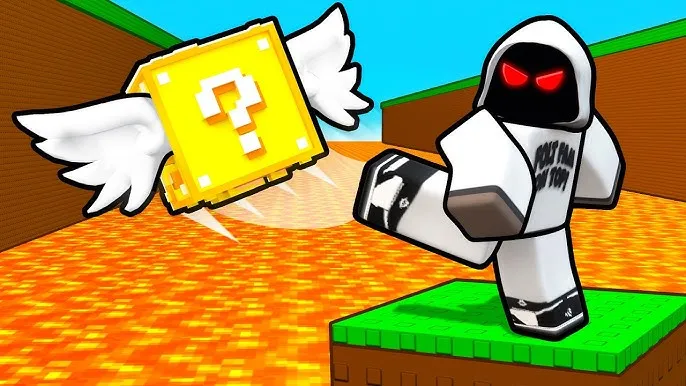
The iconography of the Lucky Block—usually a yellow cube with a white question mark—is one of the most recognizable symbols in modern gaming. This visual shorthand communicates a specific set of rules to the player before they even interact with the object. It promises Mystery and Potential.
The Anatomy of the Question Mark
- The Curve: Represents the unpredictability of the path ahead.
- The Dot: Represents the finality of the result once the block is broken.
- The Color Yellow: Universally associated with caution and gold, signaling both danger and value.
In Kick a Lucky Block, the developers often play with these symbols, introducing different colored blocks (Red for Danger, Blue for Magic, Rainbow for Ultra-Rare) to expand the symbolic vocabulary. This allows the player to perform a "triage" of their environment, deciding which risks are worth taking based on the visual cues provided by the block's skin.
8. Temporal Distortion: The "Just One More" Phenomenon
The game utilizes a concept known as Interval Reinforcement. Because the time between kicking a block and seeing the result is less than two seconds, the brain can process dozens of "gambles" in a single minute. This high-frequency interaction creates a state of "Flow," where the player loses track of time, consumed by the rapid-fire cycle of anticipation and resolution.
This temporal distortion is bolstered by the lack of a "fail state" for the act of kicking itself. You can always kick another block. Even if the last one blew up your base, the next one might contain the materials to rebuild it ten times over. This creates a forward-looking perspective where the player is always focused on the next block rather than the consequences of the current one.
9. Technological Constraints and Voxel Optimization
From a technical standpoint, spawning random entities in a physics-heavy environment is a nightmare for performance. Every time a block is kicked, the game must:
- Calculate the trajectory of the fragments.
- Consult the loot table.
- Instantiate the reward entity.
- Apply physics to that entity.
- Maintain a stable frame rate.
The "Magic" of the game is actually a feat of Culling and Memory Management. To prevent the game from crashing during high-intensity "Lucky Block Wars," the engine must aggressively de-spawn old items and optimize the collision boxes of the fragments. The seamlessness with which a block turns into a shower of items is a testament to the sophisticated backend architecture that hidden beneath the simple, playful exterior.
10. The Future of the Luck-Based Sandbox
As we look toward the future of the genre, the integration of AI-Driven Loot Tables seems inevitable. Imagine a Lucky Block that learns from your playstyle—not to give you what you want, but to give you exactly what will keep you playing longest. If you are struggling with a boss, the block might "randomly" drop a healing potion; if you are breezing through the level, it might "randomly" drop a challenge.
The evolution of Kick a Lucky Block will likely move toward more complex environmental interactions and social integration, where the "luck" of one player can affect the entire server. The block is no longer just a box; it is a portal to an infinitely variable reality, a testament to the power of randomness in digital play.